


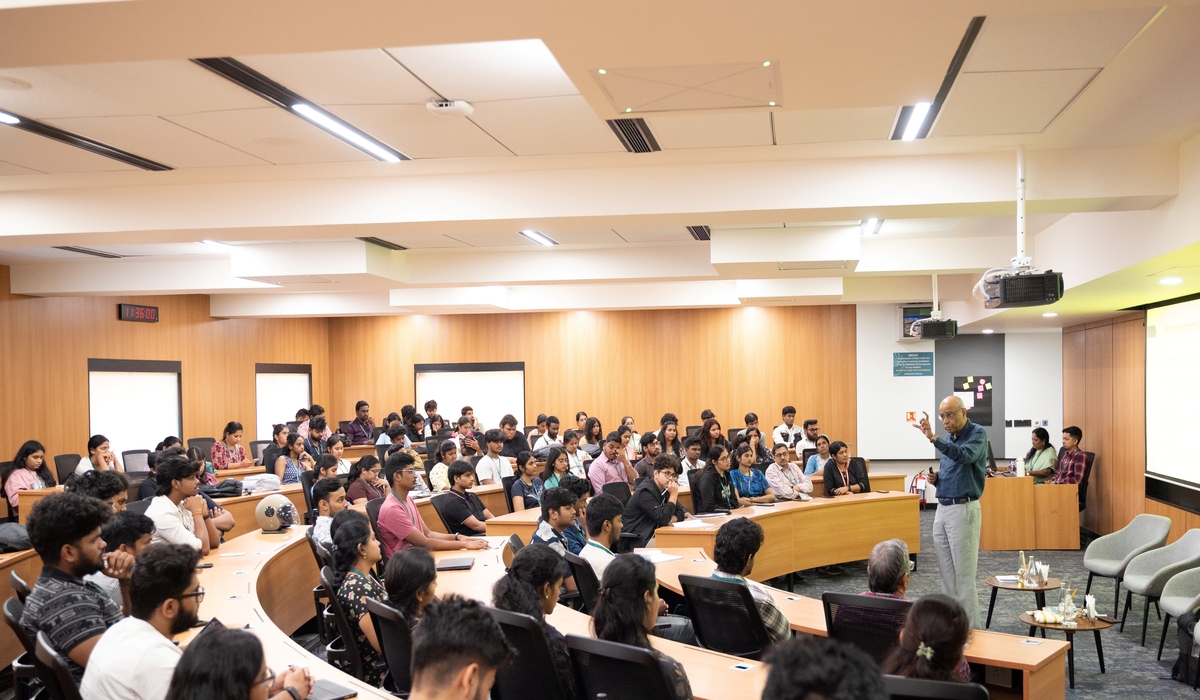
Human Capital Key to Growth: Saumen Chattopadhyay
Economics professor at JNTU-New Delhi, Saumen Chattopadhyay, said India’s development strategy since Independence has focused more on physical infrastructure than human capital. He spoke on the Union Budget 2026–27 at the GITAM School of Business, GITAM Deemed to be University, on Wednesday.
Reviewing the Budget, he asked whether India had underinvested in the foundations of long-term growth. He said education, health, and research drive productivity, innovation, and responsible citizenship.
Citing official data, Prof. Chattopadhyay said 53% of graduates and 36% of postgraduates remain underemployed. He noted that 65.3% of the labour force has no formal skills or vocational training. He added that 90.2% are educated only up to the secondary level or below. As a result, 88.2% of workers are in elementary and semi-skilled jobs. Bridging the education-employment gap, he said, must become a priority.
Referring to the “Yuva Shakti-driven” Budget, he highlighted key proposals. These include PM-SETU for ITI upgrades, expansion of secondary schools and colleges under the Orange Economy, university townships near industrial corridors, girls’ hostels in every district, and sector-linked skill programmes. He said success will depend on the quality of training and its alignment with industry needs, especially amid rapid AI-led changes.
Prof. Chattopadhyay said policymakers should measure Viksit Bharat not only by GDP growth. They should also track per capita income, inequality reduction, and improvements in education and health. Equity, inclusiveness, and sustainability, he added, will shape outcomes.