


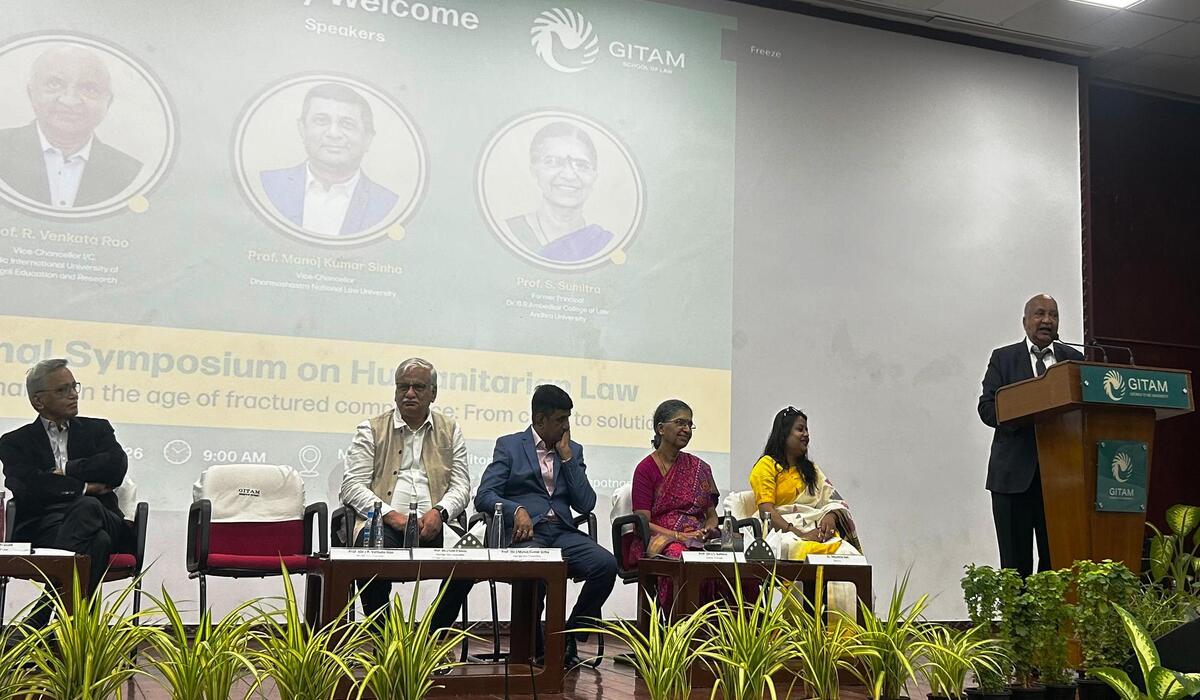
Experts flag gaps in enforcement of humanitarian law at GITAM symposium
Experts at a National Symposium on International Humanitarian Law (IHL) emphasized the urgent need for stronger adherence to laws governing armed conflicts. They warned that repeated violations of humanitarian norms reveal significant weaknesses in enforcement and accountability.
The symposium, organized by the School of Law at GITAM Deemed to be University, gathered legal scholars, academics, and practitioners to discuss humanitarian concerns arising from contemporary conflicts.
Speakers noted that International Humanitarian Law, often referred to as the law of war or the law of armed conflict, is designed to limit the effects of war and protect civilians and other non-combatants. Referencing conflicts such as Russia–Ukraine and Gaza, they noted that modern wars are leading to large-scale humanitarian crises with severe consequences for civilians.
Discussions highlighted IHL’s crucial role as a legal framework that enables and safeguards humanitarian operations in conflict zones. Experts described International Human Rights Law and International Humanitarian Law as complementary systems working toward the shared goal of protecting human dignity.
Participants also talked about the contributions of the International Committee of the Red Cross (ICRC) in promoting compliance with IHL and alleviating suffering during armed conflicts.
The event featured addresses from prominent figures, including Prof. R. Venkata Rao, In-Charge Vice-Chancellor of the India International University of Legal Education and Research; Prof. Manoj Kumar Sinha, Vice-Chancellor of Dharmashastra National Law University; and Prof. S. Sumitra, former Principal of Andhra University B.R. Ambedkar College of Law. Other speakers included Prof. Eroll D’Souza, Vice-Chancellor of GITAM, Prof. A. Rajendra Prasad, Dean of the GITAM School of Law, and Director Dr. Moumita Sen Chakraborty.
The symposium concluded with a call for renewed commitment through stronger domestic legislation, increased awareness, and enhanced institutional accountability.