


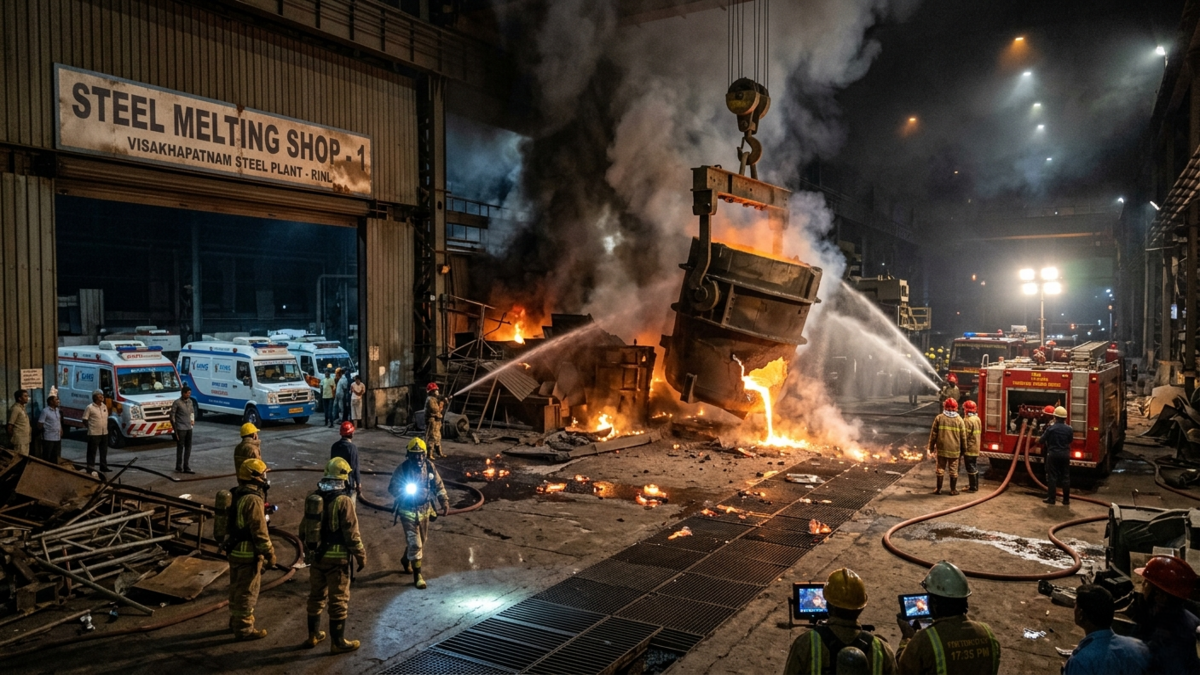
VSP Blast Triggers Probe as Experts Flag Technical Flaws, Cost Cuts
An official inquiry has been launched into the explosion at the Visakhapatnam Steel Plant on Monday that killed eight workers, as questions grow over possible equipment failure and lapses in safety systems.
Preliminary concerns raised by safety experts and former employees point to a potential “ladle breakout”, a serious industrial incident in which molten steel escapes its container following failure of the refractory lining.
A retired senior safety official said ladles are lined with heat-resistant bricks designed to withstand extreme temperatures, but wear and cracking over time can lead to catastrophic failure. He cited a similar fatal incident at Bhushan Steel’s Odisha plant in 2013.
Former employees have also raised concerns about operations in the Continuous Casting Department (CCD), alleging that cost-cutting measures may have weakened safety standards and quality controls.
Sheikh Masthan, a retired CCD employee with 35 years of service at the plant, alleged that financial pressures had led to compromises in both raw material quality and operational safety.
He said ferro-alloys such as manganese and iron ore must be properly mixed with argon gas before casting, warning that deviations in material quality or process control could trigger unstable reactions inside the vessel. He also pointed to the absence of a mandatory safety cover on the ladle, saying it significantly worsened the impact of the explosion.
He added that had such a cover been in place, molten metal would not have spread so widely across the plant floor.
The incident has intensified scrutiny of safety standards at the plant, with trade unions linking the concerns to financial stress following the Indian government’s 2021 decision to pursue full strategic disinvestment of state-run RINL.
Leaders of the Centre of Indian Trade Unions (CITU), including R K S V Kumar and K M Srinivasa Rao, alleged that funding constraints have led to deteriorating infrastructure, deferred maintenance, and increased reliance on contract labour in hazardous areas.
They have called for a judicial inquiry, an independent audit of raw material quality checks, and compensation of ₹5 crore for each victim’s family. Representatives of INTUC and CITU have echoed similar demands for stricter safety oversight and accountability.