


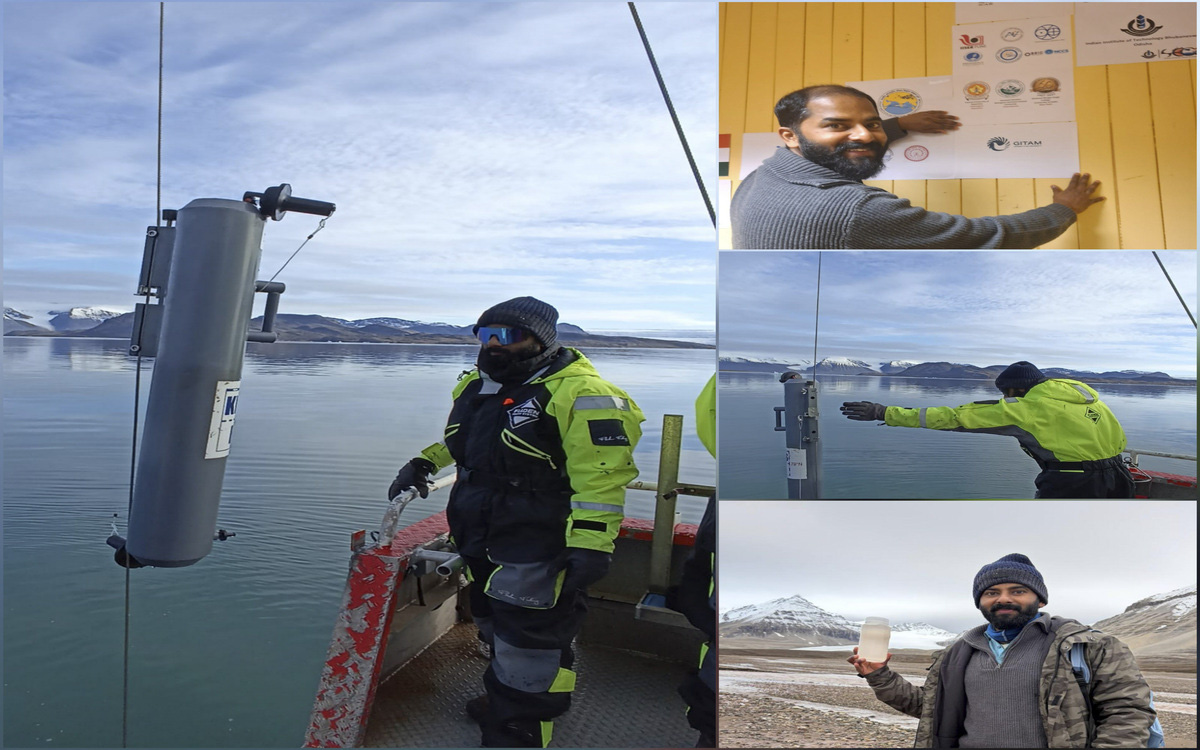
From Visakhapatnam to the Arctic: GITAM scientist on a mission to track emerging pollutants
Snowstorms, sub-zero winds and turbulent fjord waters became part of Dr Manoj P. Rayaroth’s daily routine in the Arctic. But beyond the physical extremes lay a larger scientific challenge: to understand what happens to emerging pollutants as a warming Arctic transforms its glaciers, ice and marine environment.
For the GITAM scientist, the expedition offered a rare opportunity to investigate a problem unfolding at one of the planet’s most sensitive environmental frontiers.
Speaking to The Coastal Times after completing his research mission under the Indian Arctic Expedition 2026–27, Dr Manoj said the experience offered him a rare opportunity to observe environmental processes in one of the world’s most sensitive ecosystems.
“It was an incredible experience to represent GITAM in the Arctic and work with scientists from different disciplines under extremely challenging conditions,” he said.
Dr Manoj, Assistant Professor in the Department of Chemistry at GITAM School of Science, was part of the fourth batch of the Indian Arctic Expedition. His research focuses on a question that is gaining importance as the Arctic warms: what happens to emerging pollutants trapped in or transported through ice when glaciers melt?
His project, titled “Impact of Climate Change on the Transformation of Emerging Contaminants and their Release from Arctic Ice to Marine Waters: Monitoring and Identification of Transformation Pathways,” examines how organic pollutants behave under Arctic conditions.
Dr Manoj, the Principal Investigator, worked with Prof NVS Venugopal, Head of the Department of Chemistry and Co-Principal Investigator, to study how low temperatures, glacier meltwater, and continuous solar exposure affect these contaminants.
The fieldwork took him to Ny-Ålesund in Svalbard, where India’s Himadri research station is located. He collected samples of fjord water and glacier meltwater and carried out preliminary analyses at the Himadri Marine Laboratory.
“These samples are important because they can help us understand how contaminants are transformed and transported as the Arctic environment changes,” Dr Manoj explained.
The samples will now undergo detailed laboratory analysis at GITAM using advanced analytical facilities. The researchers hope the work will provide a clearer picture of pollutant transformation pathways and their possible movement into marine ecosystems.
For Dr Manoj, however, the expedition was not confined to laboratory science. Working in the Arctic meant adapting to harsh weather and difficult conditions in the fjords.
The expedition also brought him into close contact with researchers from institutions such as the National Centre for Polar and Ocean Research (NCPOR), National Institute of Oceanography, Cochin University of Science and Technology, Centre for Marine Living Resources and Ecology, and Presidency University.
The Indian Arctic research programme is coordinated by NCPOR under the Ministry of Earth Sciences. Himadri, established in 2008 at Ny-Ålesund, serves as India’s research base in the Arctic.
Dr Manoj said the experience had strengthened his belief in collaborative and multidisciplinary research.
“The Arctic may appear distant from our everyday lives, but changes there can have wider environmental implications. Understanding these changes requires scientists from different fields to work together,” he said.
Prof C. Kavitha, Director of GITAM School of Science, congratulated Dr Manoj and said the institution would encourage students to participate in national research programmes and gain exposure to large-scale scientific projects.
Prof Venugopal said GITAM’s advanced research laboratories would enable further investigations into the samples collected during the expedition.
For Dr Manoj, the journey from GITAM’s laboratories to the Arctic was more than an academic assignment. It was an opportunity to take Indian research closer to one of the most closely watched frontiers of climate science.