


Academic Research Key to Atmanirbhar Bharat: DRDO Chief
Academic institutions play a vital role in advancing India’s Atmanirbhar Bharat mission through research on critical and strategic materials, said Dr. R.V. Hara Prasad, Director General of the Defence Research & Development Organisation (DRDO).
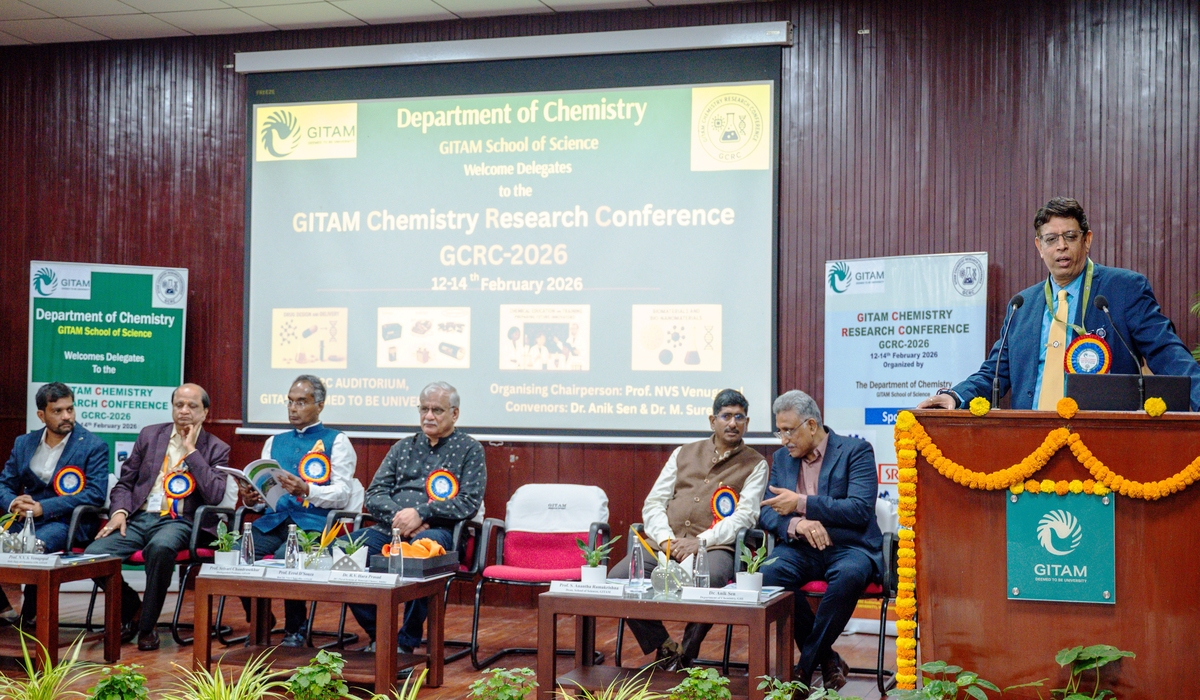
Inaugurating the three-day GITAM Chemistry Research Conference (GCRC-2026) at GITAM Deemed to be University on Thursday, Dr. Hara Prasad said materials development is a long-term effort that requires collaboration.
He noted that research conducted in isolation often fails to translate into deployable technologies. “Meaningful outcomes require close coordination among R&D organisations, academia, and industry,” he said.
Dr. Hara Prasad highlighted India’s focus on the indigenous development of semiconductor-grade silicon, advanced ceramics, and high-temperature-resistant materials essential for missile and strategic systems. He added that DRDO has established 15 Industry–Academia Centres of Excellence (DIA-CoEs) to promote directed research and partnerships among DRDO laboratories, universities, and start-ups.
Referring to the expanded DRDO Technology Development Fund (TDF), he said the scheme supports MSMEs and start-ups developing indigenous defence technologies to reduce import dependence.
He also called for integrating artificial intelligence, digital competencies, and sustainability into research strategies.
Former Secretary of the Department of Science & Technology Prof. S. Chandrasekhar urged faculty members to intensify research on indigenous materials.
GITAM Vice-Chancellor Prof. Errol D’Souza outlined the university’s research priorities, highlighting chemistry’s role in advanced materials development.
Dean of the GITAM School of Science Prof. Ananta Ramakrishna, Conference Chairman Prof. N.V.S. Venugopal, and Convenors Dr. Anik Sen and Dr. M. Suresh were present.
The conference features sessions on AI in materials research, drug discovery, fuel cells, batteries, biomaterials, and industry–academia partnerships. Scientists, researchers, faculty members, and students are participating.