


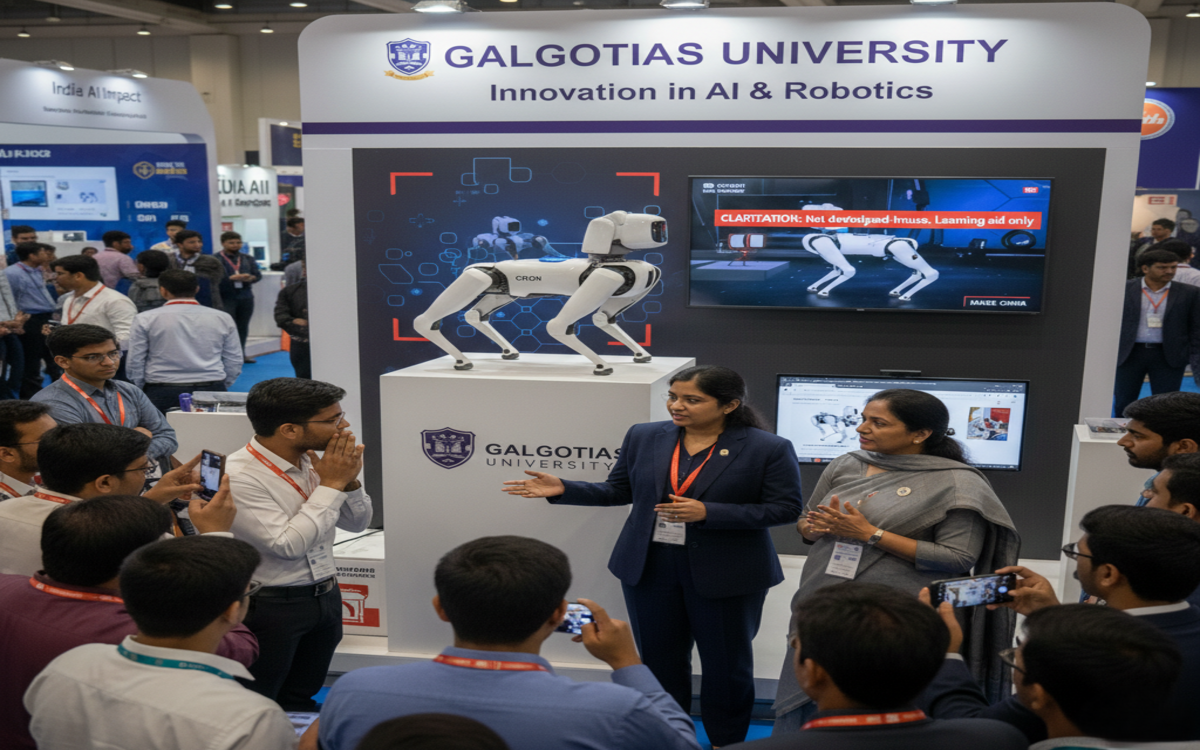
AI Summit Incident Raises Credibility Concerns
The controversy surrounding Galgotias University’s presentation at the recent India AI Impact Summit has widened into a broader debate on research integrity, the authenticity of innovation claims, and oversight at high-profile technology events.
A robotic dog displayed at the university’s stall, introduced as “Orion,” drew attention after online observers identified it as the Unitree Go2, a commercially available quadruped robot manufactured in China. A video of the demonstration quickly went viral, prompting scrutiny from participants and organisers.
Summit organisers subsequently distanced themselves from the episode, reiterating that exhibits were expected to reflect genuine research or demonstrable innovation. Government officials also underscored the importance of accuracy and transparency in representations made at national forums dedicated to emerging technologies.
Galgotias University later issued a clarification stating that it had not developed the robotic dog. The institution said the display was intended as a learning aid to inspire students rather than as an in-house technological product. The faculty member involved acknowledged a lapse in communication, describing the incident as an unintended misrepresentation.
Observers say the controversy highlights deeper structural challenges within segments of the academic and research ecosystem. Analysts point to pressures linked to visibility, rankings, and the race to showcase innovation, factors that can blur distinctions between original research, adaptation, and presentation.
“Credibility remains the cornerstone of academic institutions. Even inadvertent misstatements can weaken public trust,” said a senior professor familiar with research governance frameworks.
Policy specialists argue that organisers of technology summits must adopt clearer provenance verification norms. Suggested safeguards include mandatory disclosure on whether showcased hardware is proprietary, licensed, or commercially sourced, along with independent audits of innovation claims.
Within universities, experts stress the need for systematic ethics training, transparency in collaborative projects, and internal review mechanisms governing external demonstrations. “The distinction between demonstration, adoption, and innovation must be explicit,” noted a research policy consultant.
Industry leaders caution that, as India seeks to position itself as a global hub for artificial intelligence and deep-tech research, reputational setbacks can carry long-term consequences. Commentators say the episode should serve as an impetus for reform.