


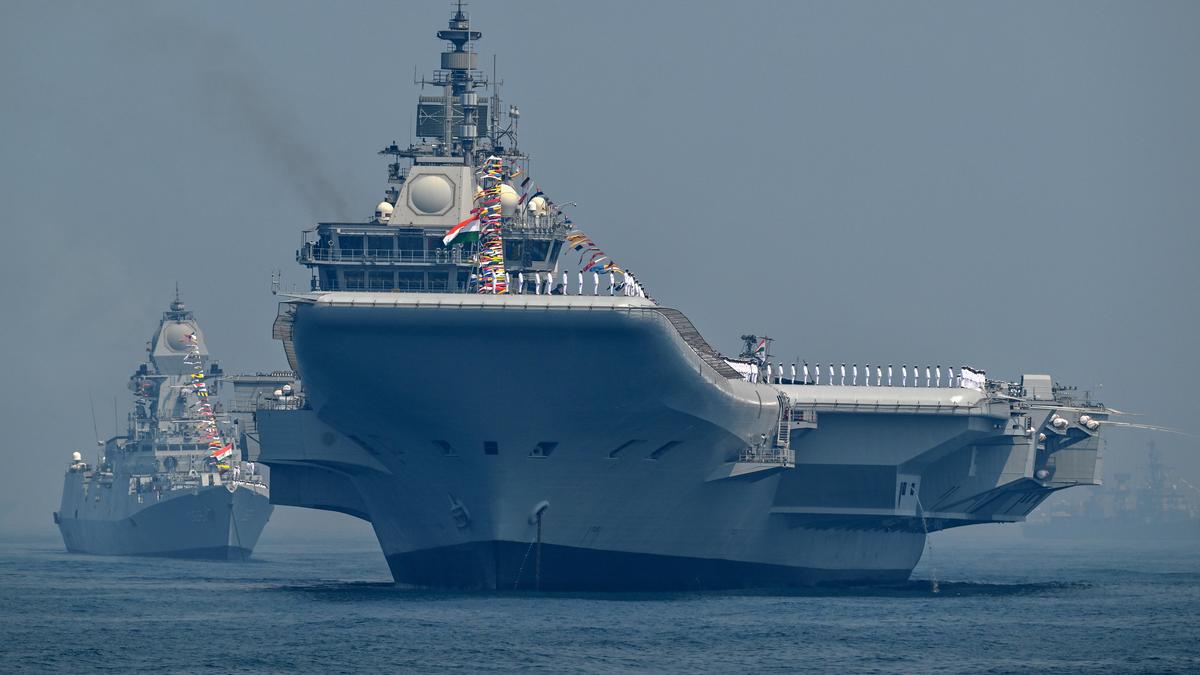
INS Vikrant dominates attention at IFR, MILAN-2026
INS Vikrant has become the main attraction off the Visakhapatnam coast during the International Fleet Review (IFR) and MILAN-2026. The high-profile events have brought together more than 70 warships from the Indian Navy and friendly foreign navies. Together, they showcase India’s expanding maritime strength.
As India’s first indigenously built aircraft carrier, Vikrant marks a decisive shift in naval capability. It reflects the country’s move from foreign acquisitions to self-reliance.
A senior defence official said, “By building and operating the 45,000-tonne Vikrant, India has joined a select group of nations with aircraft carrier capability.” With Vikrant operating alongside Vikramaditya, the Navy now maintains two carrier battle groups. As a result, India has strengthened its blue-water reach.
Beyond symbolism, Vikrant plays an operational role. It supports the Prime Minister’s SAGAR (Security and Growth for All in the Region) vision. The carrier can function as a mobile airfield and command platform. In addition, it can coordinate joint operations, deliver humanitarian aid, support disaster relief, and project credible deterrence across the Indo-Pacific.
Naval officials also highlighted Vikrant’s diplomatic value. An Eastern Naval Command (ENC) officer described it as a “convening power.” Notably, participation from over 70 nations, including the United States and Russia, signals growing trust in India’s security role.
Furthermore, foreign naval commanders view Vikrant as visible proof of Aatmanirbhar Bharat. “The carrier signifies India’s transition from a stakeholder to a provider of regional stability,” the officer said.
Currently anchored about 12 nautical miles off the Visakhapatnam coast in the Bay of Bengal, Vikrant has drawn steady attention from residents. Its imposing silhouette has stirred memories of its legendary predecessor, which played a key role in the 1971 Indo-Pakistani War.
However, officials stressed that this Vikrant tells a new story. It stands as India’s largest indigenously built warship. More importantly, it underlines the country’s shipbuilding capability and strengthens its maritime security posture in the Indian Ocean.