


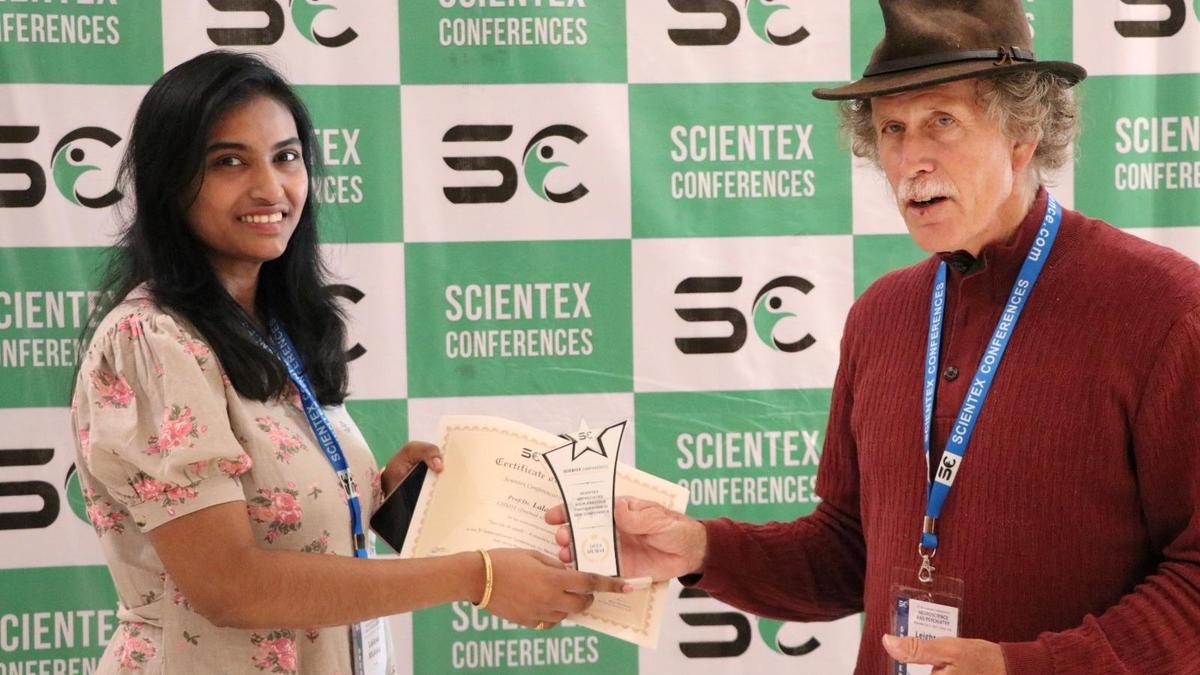
Tirupati researcher shows AI can flag cervical cancer risk early
Artificial Intelligence (AI), though still evolving, may help doctors predict cervical cancer risk years in advance and detect anxiety patterns linked to suicidal tendencies among youth, says Tirupati-based researcher Lalasa Mukku.
Ms. Lalasa has developed a learning system that identifies cervical cancer risk nearly five years before a malignant tumour forms. “AI-based colposcopy image analysis enables early detection of cervical precancerous lesions,” she explained. “This allows clinicians to recognise cancer risk long before tumours become clinically detectable.”
An alumna of Tirupati institutions, Ms. Lalasa pursued her PhD in Computer Science and Engineering at CHRIST (Deemed to be University), Bengaluru. Her doctoral research, titled ‘A multimodal temporal hybrid deep learning model for cervical cancer detection’, was carried out under the guidance of Professor Jyothi Thomas.
Quoting GLOBOCAN data, Ms. Lalasa said India recorded over 1.23 lakh new cervical cancer cases and nearly 77,000 deaths in 2020. She added that early diagnosis can raise the five-year survival rate to nearly 90%.
Her AI-driven system tackles the shortage of trained specialists by enabling computers to interpret colposcopy images. The study uses a colposcope to capture images of the cervix. An AI module called the ‘Enhanced Gaussian Mixture Model’ isolates the cervix region for clearer analysis.
When doctors feed periodic images into the system, it tracks changes in tissue colour, texture, and vascular patterns. These subtle morphological variations help detect precancerous developments well before tumour formation.
“During validation, the model achieved 94% accuracy, a 95% recall rate, and an F1 score of 94.21,” Ms. Lalasa said. “The results surpassed conventional diagnostic benchmarks.” Her research has earned three national patents and has appeared in more than twenty SCOPUS-indexed journals.
Beyond cancer detection, Ms. Lalasa also worked on an AI-based project to assess anxiety levels among young individuals. The system aims to identify early warning signs of suicidal tendencies and enable timely intervention. The findings were published in an SCI-indexed journal with an impact factor of 13.9.
Her invited talk on this research received appreciation at the 3rd International Conference on Neuroscience and Psychiatry organised by Scientex Conferences in Dubai in 2023.