


Visakhapatnam’s Path to a Trillion-Dollar Economy
C.M. Saikanth Varma, CEO of the Andhra Pradesh Economic Development Board (EDB), said digital infrastructure must be treated as a core utility, alongside water, electricity, and roads. He added that this step is essential for Visakhapatnam to grow into a trillion-dollar regional economy.
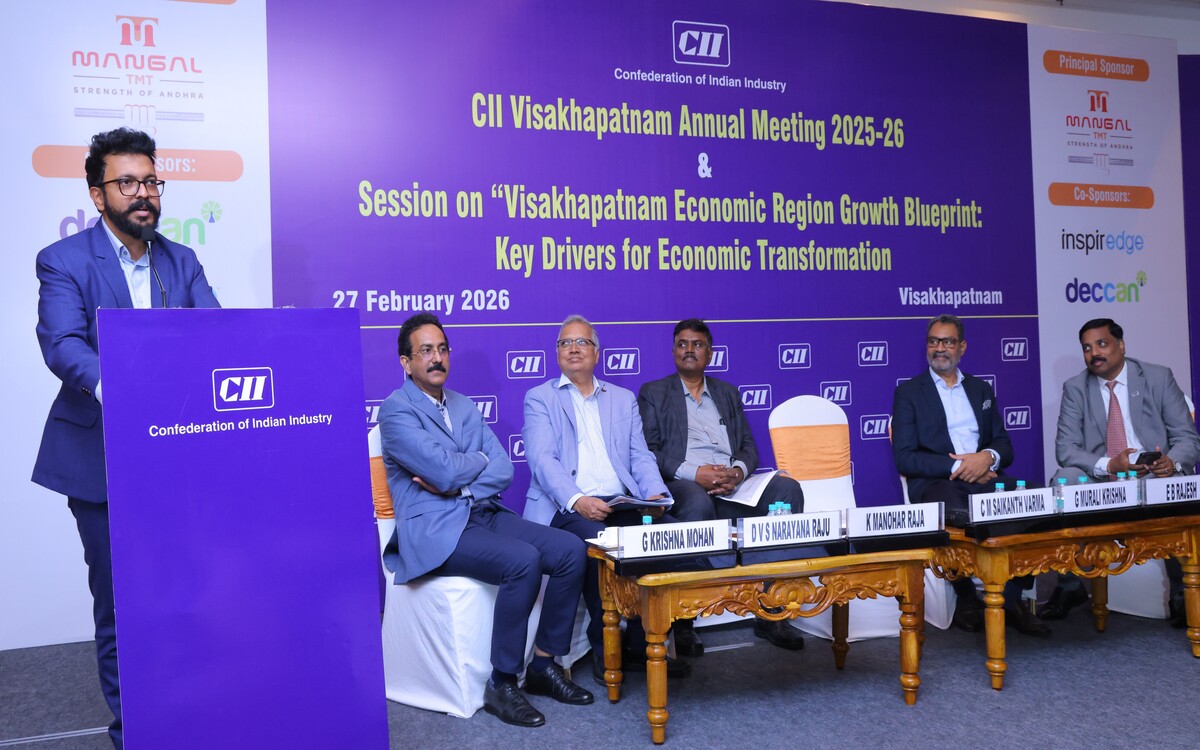
Speaking at the Confederation of Indian Industry (CII) Visakhapatnam Zone Annual Members Meeting 2025–26, Mr. Varma said the city is quickly becoming a national hub for AI computing. Moreover, he highlighted upcoming projects, including gigawatt-scale AI data centers, a proposed AI Hub for 2026–2030, and new subsea cable landings on the eastern coast.
“Modern cities should be judged not only by size but also by governance, investor confidence, and climate resilience,” he said. He added that policies like the Data Center Policy 4.0 and the Clean Energy Policy attract global companies such as Google, ArcelorMittal, and Cognizant.
Mr. Varma also pointed out that Visakhapatnam contributes nearly 30% of Andhra Pradesh’s GSDP. Therefore, to support the state’s $2.4 trillion economy goal by 2047, the city must aim for a trillion-dollar milestone.
To achieve this $1 trillion target, he outlined seven growth pillars: port-led manufacturing, aviation logistics through Bhogapuram Airport, advanced digital infrastructure, aquaculture, specialized tourism, pharmaceuticals, and integrated metro connectivity. Furthermore, he emphasized that these sectors should rely on a unified “digital stack” combining energy, computing, and cybersecurity. This approach ensures efficient governance and scalable economic growth.
In a special address, K. Manohar Raja, Principal Executive Director (Southern Region) at RailTel Corporation of India, said that ports, airports, highways, railways, and logistics must work together as one system to boost export competitiveness.
Finally, Murali Krishna, Chairman of CII Andhra Pradesh, said Visakhapatnam is at a critical point. With coordinated development of infrastructure and the knowledge economy, the city can become a gateway for trade, technology, and high-value jobs.