


Vizag proposed for proton accelerator under India’s thorium programme
Andhra Pradesh could play a role in India’s long-term nuclear research programme, with a high-energy proton accelerator proposed to be set up in Visakhapatnam as part of efforts to harness the country’s vast thorium reserves.
Speaking during a Press Information Bureau media visit to the Raja Ramanna Centre for Advanced Technology (RRCAT) in Indore on Monday, Dr Jishnu Dwivedi, Director of the Technology Development and Support Group, said the proposed facility would form a key component of India’s accelerator-driven systems.
“The proton accelerator is part of India’s long-term nuclear programme. Since the technology is extremely complex and expensive, the system may take a couple of decades to become fully operational,” he said.
Once operational, the accelerator will generate high-energy neutrons through spallation reactions, enabling the conversion of thorium into uranium fuel for nuclear reactors. India possesses some of the world’s largest thorium reserves.
Dr Dwivedi said Visakhapatnam was identified as a suitable location due to its technological ecosystem and proximity to the sea, which can provide the large volumes of cooling water required for such high-energy systems.
Established in 1984 under the Department of Atomic Energy, RRCAT conducts research in particle accelerators and laser technologies with applications in space, defence, communications and medical science.
Dr Dwivedi said RRCAT’s linear accelerators also support electron beam facilities that sterilise medical devices exported to more than 35 countries.
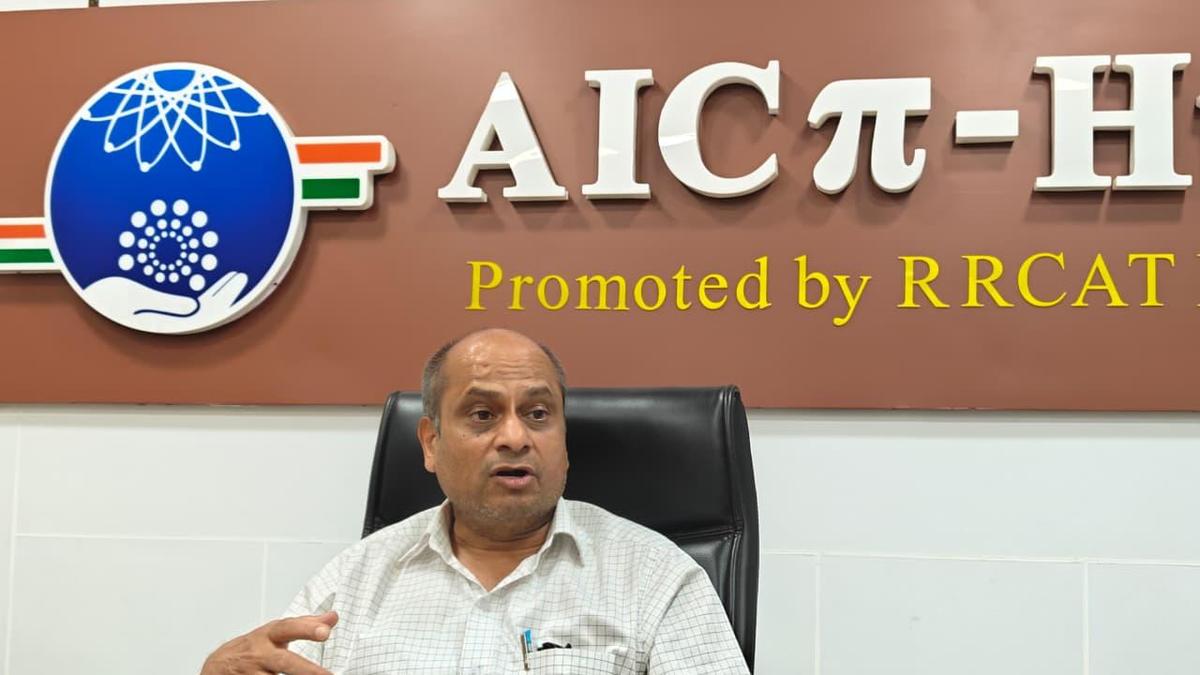
Meanwhile, RRCAT’s incubation centre, AIC-RRCAT Pi-Hub, has signed 32 agreements with industries and startups over the past two years, with nine ventures currently collaborating, said its convener Dr Christ Prakash Paul.
He said one startup is developing affordable metal 3D-printing technology for space and defence applications, while emerging technologies such as fibre-based optical sensors and cryogenic cooling systems for MRI machines could create a market worth about ₹1,000 crore by 2028.