


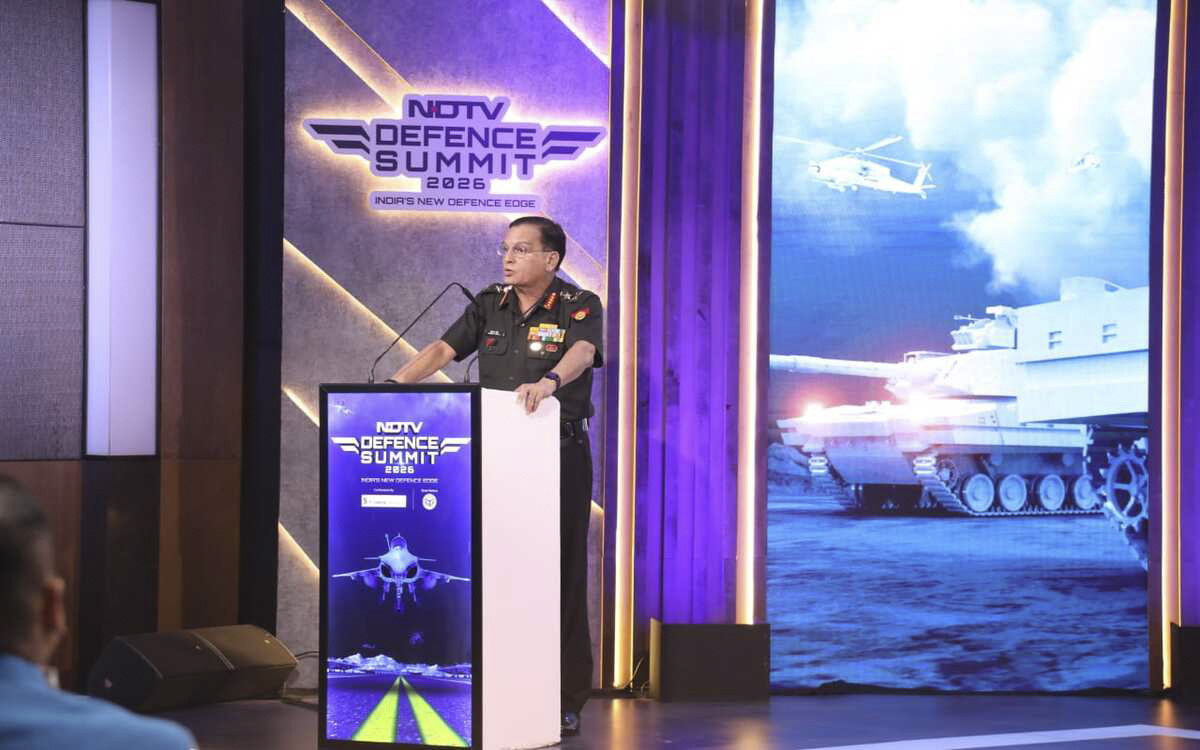
Army Chief calls for capability to sustain prolonged wars
India’s defence preparedness must go beyond indigenous production and focus on the ability to sustain, adapt and regenerate military capability during prolonged conflicts, Chief of the Army Staff General Dhiraj Seth said on Sunday.
Speaking at a Defence Conclave on “Aatmanirbharta in an Era of Transformative Wars”, Gen. Seth described contemporary conflicts as “wars with pause”, saying technology may be shortening battles but not necessarily wars.
Unlike earlier conflicts, which often had a clearly identifiable end, present-day wars could involve prolonged periods of uncertainty punctuated by intense fighting, he said.
“Technology may be shortening battles, but it is not necessarily shortening wars. These are ‘wars with pause’,” Gen. Seth said.
He said the pace of technological change was increasingly outstripping the time taken to develop and induct military systems. “The capability clock today moves slower than the technology clock,” he said, stressing that indigenisation should also ensure that a system remained relevant when it entered service.
India’s diverse operational environment, from sea level to super-high altitudes and from extreme heat to sub-zero temperatures, also ruled out a “one size fits all” approach to capability development, he said.
The Army Chief pointed to the changing economics of warfare, noting that a drone costing a few hundred dollars could threaten a platform worth millions of dollars. The ability to innovate, adapt and counter threats faster, therefore, would be critical, he said.
Gen. Seth also cautioned against treating older military equipment as obsolete. Air-defence guns inducted decades ago, he said, could remain effective against drones and drone swarms when integrated with modern sensors, fire-control systems and smart ammunition.
Modernisation, he said, need not always mean replacing existing platforms.
He also stressed the need for both long-range capabilities and forces capable of occupying and holding ground, particularly along disputed borders. “The Indian Army needs both, the long arm and the strong arm,” he said.
While information warfare had gained importance, land would remain central to military outcomes, Gen. Seth said. “The soldier will ultimately occupy, secure and defend that territory.”
He outlined SAMARTH as a framework for capability development, standing for Sustain, Adapt, Mission-Ready Modernisation, Accelerate, Resilience, Technology-led Transformation and Human-Machine Teaming.
Gen. Seth said defence exports crossed ₹38,000 crore in 2025-26, with 159 of 175 types of ammunition used by the Army having been indigenised. Nearly 16,000 MSMEs were participating in defence production, he said.
Aatmanirbharta, he added, should provide India with strategic freedom rather than merely substitute imports. “Aatmanirbharta gives us the freedom to fight. Capability gives us the ability to fight. The Yoddha gives us the will to fight,” he said.