


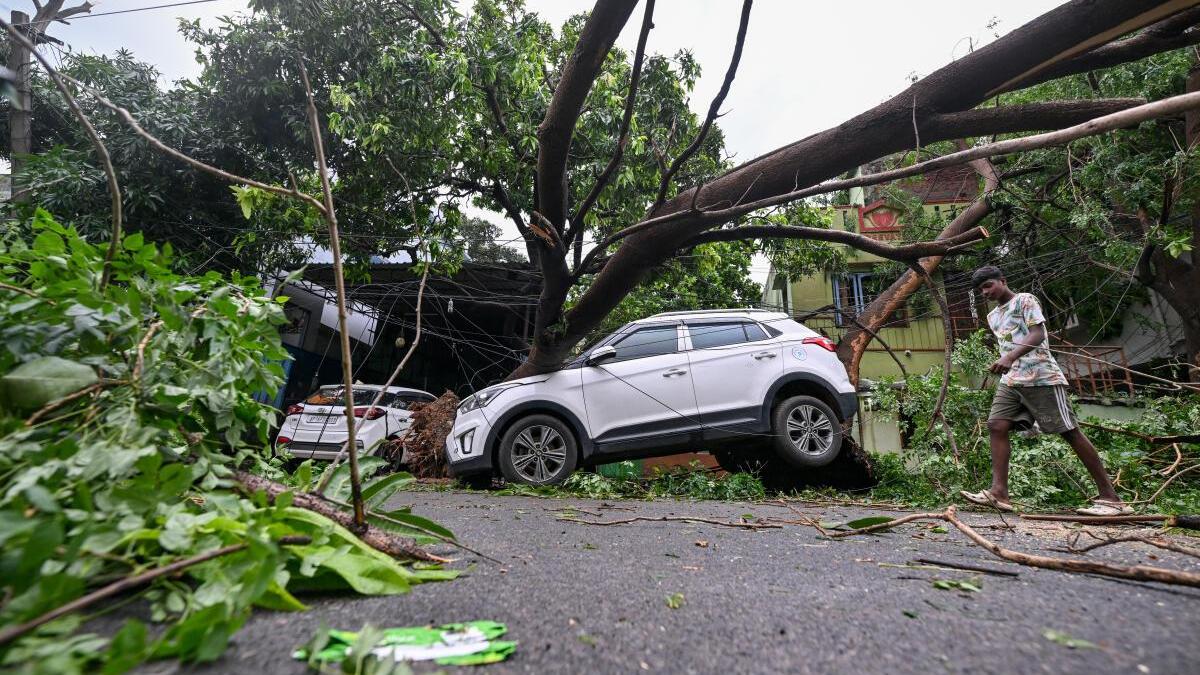
12 Years After Hudhud, Cyclone Arnab Leaves Visakhapatnam Shaken
For many Visakhapatnam residents, the howling winds that swept through the city brought back an unsettling sense of familiarity. Twelve years after Cyclone Hudhud left a trail of destruction, Cyclone Arnab revived memories of sleepless nights, uprooted trees, darkened neighbourhoods, and disrupted communication networks.
Arnab may not have matched Hudhud’s fury or made landfall in Visakhapatnam, but its impact was enough to rekindle memories of October 12, 2014, when the coastal city bore the brunt of one of its most devastating cyclones.
As strong winds battered the city through the night, residents once again found themselves grappling with prolonged power outages, damaged electricity infrastructure and disrupted mobile connectivity. Social media platforms were flooded with recollections of Hudhud, with many drawing parallels between the two cyclones.
For P. Ramya, a resident of Seethammadhara, the experience was an unsettling reminder of her student days. She was pursuing her degree when Hudhud struck in 2014. Now a homemaker, she found herself reliving those anxious moments as powerful winds lashed her home.
“Hudhud began at night and lasted nearly 36 hours. Though Arnab was not as strong, the powerful winds at night felt like a milder version of Hudhud. The winds hit our balcony directly,” she recalled.
The similarities did not end with the winds. As the power outage continued, Ramya’s family had to make arrangements they had not made since Hudhud.
“We had to arrange diesel to run generators, something we had done during Hudhud 12 years ago but had not needed to do again until now,” she said.
For Sashikanth Sukumaran, a businessman from Beach Road, Arnab was a reminder of how much the city had changed since Hudhud and how vulnerable it remained to severe weather.
Sukumaran, who was a B.Tech student when Hudhud struck, said widespread publicity and advance warnings about Arnab had heightened concerns over its possible impact. Although the cyclone did not make landfall in Visakhapatnam, its powerful winds caused considerable damage, he said.
Sukumaran pointed out that disaster preparedness, public awareness and the dissemination of weather alerts had improved considerably over the past 12 years. However, prolonged power outages and mobile network disruptions showed that cyclones can still bring everyday life to a standstill.
While residents recalled the similarities, experts highlighted significant differences in the tracks and intensity of the two cyclones.
K.S.R. Murthy, a former scientist at the National Institute of Oceanography and a member of the Andhra Pradesh Federation of Resident Welfare Associations, said Hudhud’s direct landfall and extremely powerful winds had made it particularly destructive.
“Hudhud made a direct landfall on the Vizag coast on October 12, 2014, with a relatively direct track and extremely strong winds. The limited deviations in its path and its impact on a densely built-up urban area contributed to the extensive destruction, even though rainfall was comparatively low,” he explained.
Arnab, on the other hand, developed during the northeast monsoon season and followed a more erratic path, he said.
Although its winds were weaker than those of Hudhud, they were powerful enough to cause extensive damage to plantations in the Godavari region, Murthy added.
He observed that the damage to Visakhapatnam’s green cover was particularly striking, with no cyclone in recent years having caused comparable destruction to the city’s vegetation.
For residents who witnessed Hudhud’s devastation, Arnab was more than another spell of severe weather. It was a stark reminder of a disaster that remains etched in the city’s collective memory, even 12 years later.