


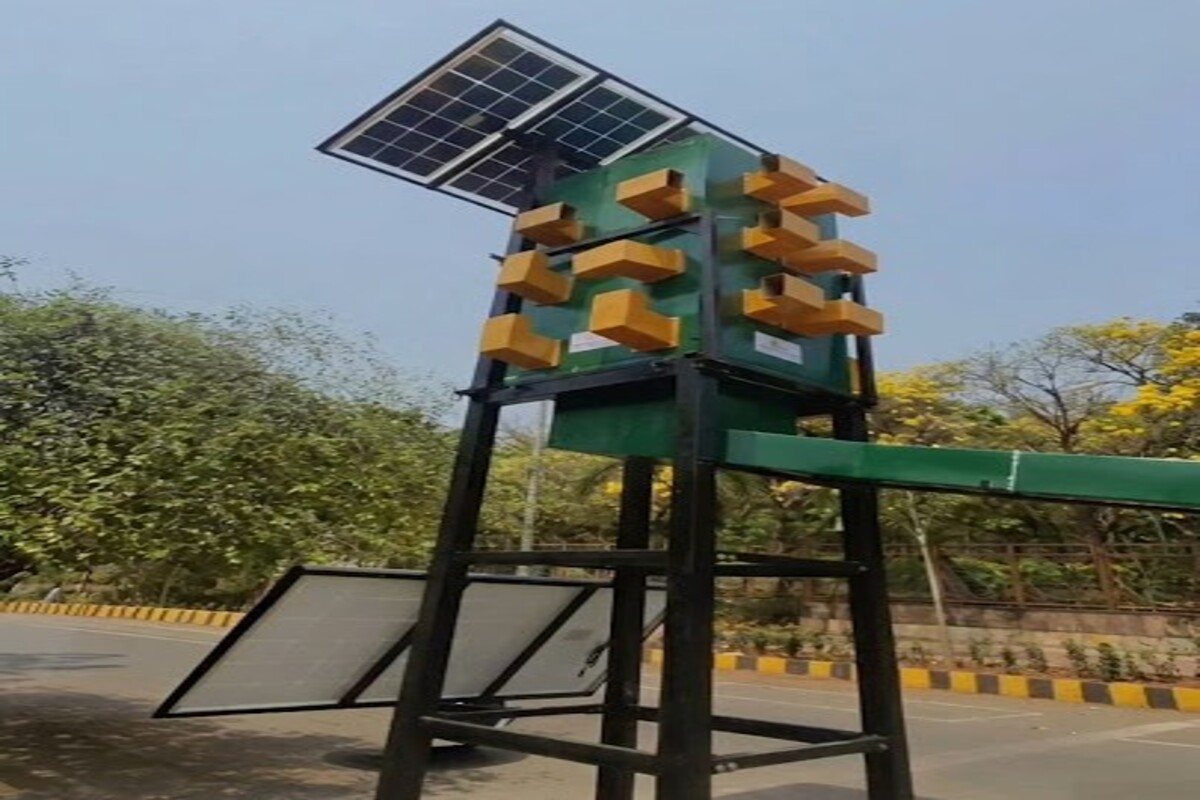
Air pollution control device delivers encouraging results
With air pollution levels rising steadily in urban centres and posing increasing health risks, a newly developed air pollution mitigation device has shown encouraging results during a pilot installation in Visakhapatnam, offering a potential solution for improving ambient air quality in open spaces.
The device, developed by Neetha Innovative Technology Company, has been installed near Central Park as part of a proof-of-concept exercise, with the approval of the Pollution Control Board. Designed to function in outdoor environments, it operates on solar power with battery backup and is capable of purifying air across an area of approximately 200 square metres.
“During the initial trial, the Air Quality Level (AQL) in the area was around 180 in the morning. After the device was activated, it dropped to 80, with further improvement observed at night,” said K.M. Lakshmana Rao, a retired professor of JNTU-H who led the research behind the innovation. He added that the results indicate the system’s potential to significantly reduce pollution levels in high-exposure zones.
Mr. Lakshmana Rao explained that the system specifically targets suspended particulate matter, including fine solid and liquid particles commonly found in Visakhapatnam’s air due to vehicular emissions, industrial activity, and coastal conditions. “The technology allows us to calibrate the system based on the type and concentration of pollutants in a given area. This makes it adaptable to different urban environments,” he said.
The innovation is the outcome of nearly nine years of sustained research and field testing. According to the developer, the system combines filtration and air circulation mechanisms to continuously draw in polluted air, process it, and release cleaner air back into the surroundings.
Officials noted that similar units have already been installed in Hyderabad, while another is expected to be set up in Cyberabad shortly as part of wider testing and validation efforts.
Describing the device as a large-scale “oxygen booster,” Mr. Lakshmana Rao said it could play a crucial role in improving public health if deployed strategically. “If installed at traffic junctions, residential complexes, industrial zones, and other high-density areas, the system can deliver measurable improvements in air quality and reduce exposure to harmful pollutants,” he said.
Officials from the Pollution Control Board also expressed optimism about the initiative. “Such technologies can complement existing pollution control measures. If the results are sustained over time, they could become part of a broader strategy to tackle urban air pollution,” a senior official said.