


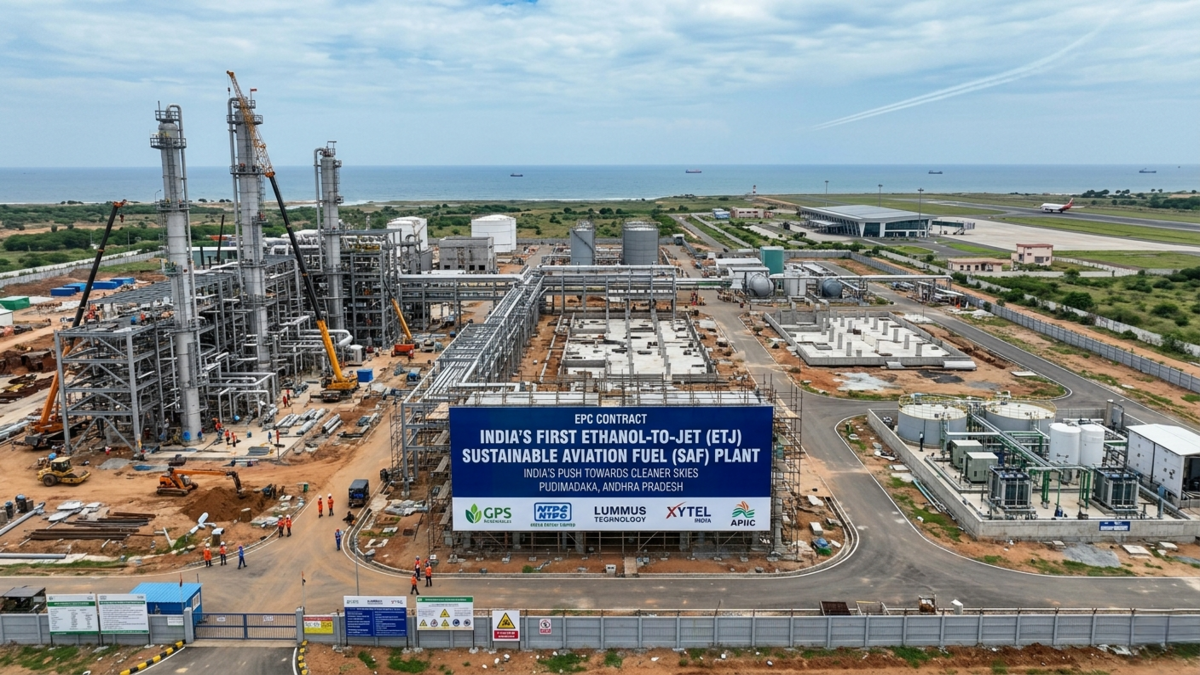
NTPC, GPS Renewables to build India’s first SAF plant in AP
In a significant push towards cleaner skies, Bengaluru-based GPS Renewables (GPSR) has begun construction of India’s first Ethanol-to-Jet (ETJ) Sustainable Aviation Fuel (SAF) plant, following the award of an Engineering, Procurement and Construction (EPC) contract by NTPC Limited.
The facility will be set up at the Green Hydrogen Hub of NTPC Green Energy Limited at Pudimadaka, within the APIIC industrial area in Atchuthapuram, Anakapalle district — marking Andhra Pradesh as the launchpad for the country’s emerging domestic SAF sector.
GPS Renewables will lead the project as the primary contractor, working alongside global technology partners. Lummus Technology will supply the ETJ technology licence and basic engineering design, while Xytel India will take charge of the detailed engineering for the core process package.
The scope spans end-to-end execution — from engineering and procurement to construction, start-up, and commissioning — and includes hydrogen generation systems as well as offsite and utility infrastructure. Completion is targeted by March 2029, with a year of post-commissioning operations to follow.
The plant is designed to produce 1,800 tonnes per annum of sustainable aviation fuel, using ethanol derived from carbon dioxide. The production process converts ethanol to ethylene, which then undergoes olefin oligomerisation and hydroprocessing to yield SAF and renewable diesel.
Mainak Chakraborty, Co-founder and CEO of GPS Renewables, said sustainable aviation fuel “remains a critical pathway to reducing emissions in the aviation sector,” adding that the partnership with Lummus Technology would enable scalable SAF production in India through proven process technologies.
Romain Lemoine, Chief Business Officer at Lummus Technology, said the project marked a pivotal shift — moving ethanol-to-jet technology from concept to commercial deployment. He noted that India’s thriving ethanol ecosystem provided a strong foundation for such industrial-scale initiatives.
GPS Renewables, headquartered in Bengaluru, has carved a niche in renewable fuels — spanning biogas and compressed biogas — and has joined hands with public sector oil companies to expand biofuel infrastructure across the country. The Anakapalle plant now sets the stage for India’s aviation sector to take a meaningful step towards net-zero emissions.