


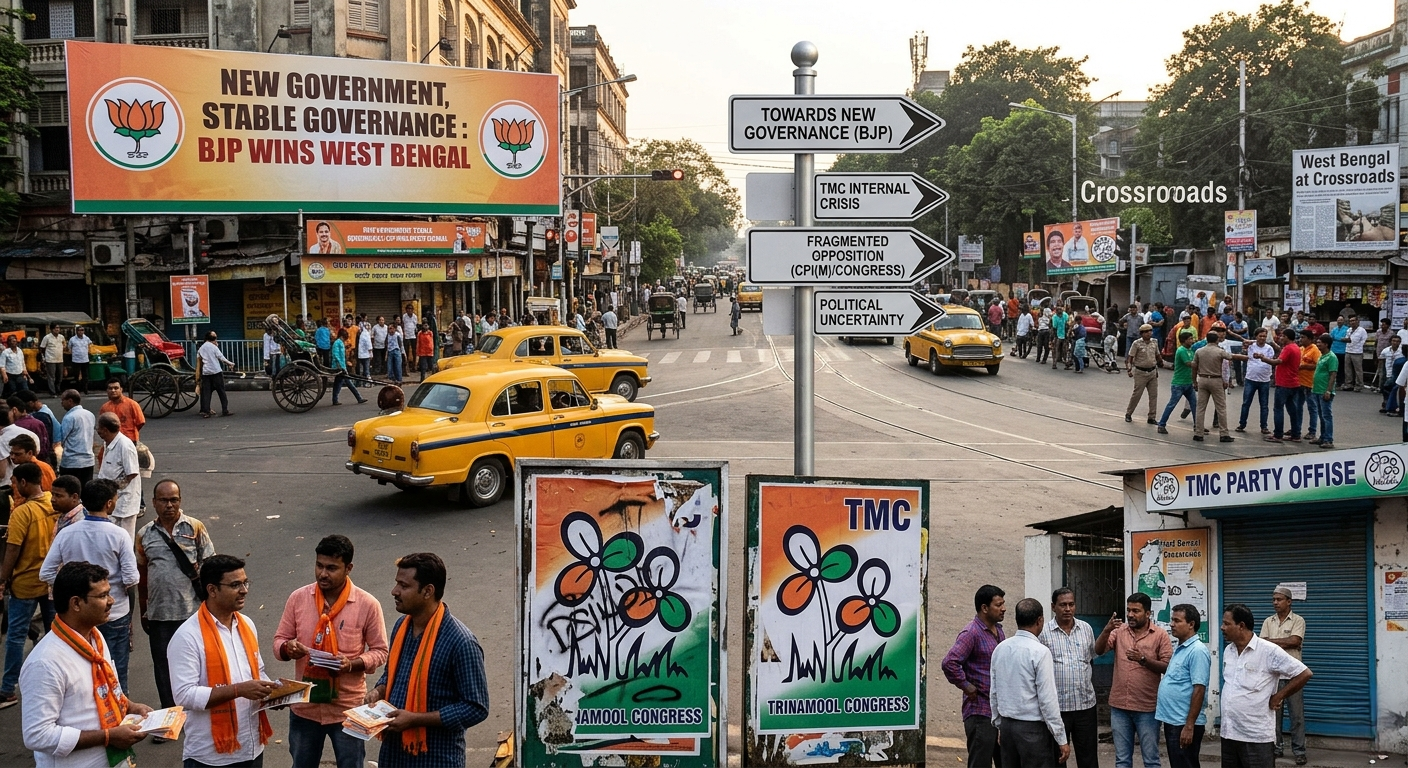
West Bengal at Crossroads: New Government, Old Party in Crisis
West Bengal is undergoing a major political transition marked by a change in government, growing instability within the opposition, and a rapidly shifting political balance that is redefining the state’s power structure.
The Bharatiya Janata Party (BJP) has formed the new government after a decisive electoral victory, ending the Trinamool Congress (TMC)’s long-standing rule. The new administration has begun reshaping governance priorities, focusing on administrative restructuring, welfare delivery alignment, and institutional reforms aimed at strengthening the state machinery.
Political analyst Dr. S. Mukherjee described the shift as “one of the most significant realignments in West Bengal politics in decades,” adding that “the real challenge for the new government is not just winning power, but converting that mandate into stable governance in a highly polarised environment.”
Despite the change in leadership, the post-election atmosphere remains tense, with reports of sporadic political clashes and continued allegations between rival party cadres over electoral conduct and local influence in several districts.
The most serious political disruption, however, is unfolding within the TMC itself. The party is facing an internal crisis marked by factional divisions, dissent among legislators, and weakening organisational control. Reports suggest that internal structures have been reorganised under pressure from competing groups within the party, raising questions about its cohesion and long-term stability.
Senior political commentator Prof. A. Banerjee observed that “what is happening inside the TMC is not just factionalism, but a structural weakening of party discipline. If left unresolved, it could permanently reshape opposition politics in Bengal.”
The crisis has also triggered wider political ripple effects. Opposition space is becoming increasingly fragmented, with the CPI(M) and Congress attempting to regain relevance in pockets where they were once strong, though without presenting a unified strategy.
According to political observer S. Iqbal, “West Bengal is witnessing a multi-layered transition where the ruling party is consolidating, the opposition is fragmenting, and traditional vote bases are becoming increasingly fluid.”
Meanwhile, the BJP-led government is also facing governance pressures. Key challenges include maintaining administrative efficiency, managing political polarisation, and delivering on development commitments in a state known for strong political mobilisation and public scrutiny.
Analyst Dr. Meera Sen noted that “the biggest test for the ruling party will be balancing governance with political sensitivity. In West Bengal, public sentiment shifts quickly, and governance failures often translate into immediate political consequences.”
With both the ruling party and opposition undergoing significant transformation, West Bengal’s political environment is entering a phase of uncertainty and recalibration. The coming months are likely to determine whether the state stabilises under a new political order or continues to experience prolonged fragmentation and realignment.