


AP’s Tele-MANAS shines as mental health calls triple
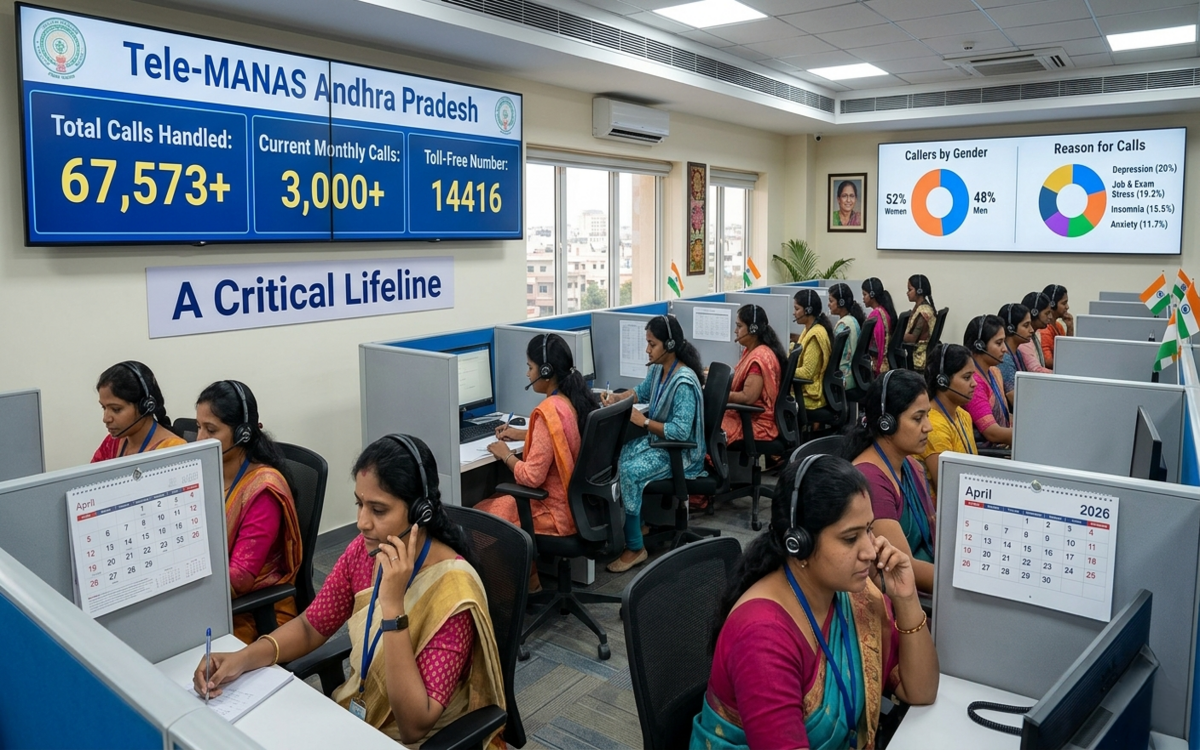
In a state where mental health has long been a subject spoken about in hushed tones, a toll-free phone number is quietly rewriting the narrative. The Tele-MANAS helpline — launched by the Union government in 2022 under the National Mental Health Programme — is now fielding nearly 3,000 calls every month across Andhra Pradesh. The threefold surge underscores both the scale of unmet mental health needs and the growing willingness of citizens to seek help.
Operated nationally by NIMHANS, Bengaluru, and accessible round the clock on 14416, the service routes callers to dedicated state-level centres, making professional counselling available to anyone with a phone — regardless of geography or income.
The reach of such a service is especially significant in a state where psychiatrists and therapists remain concentrated in urban centres, leaving millions in semi-urban and rural areas with little or no access to mental health support.
Andhra Pradesh’s two centres — in Vijayawada and Visakhapatnam, established in 2022 and 2023 respectively — have collectively handled 67,573 calls since inception, connecting tens of thousands of individuals to support they may otherwise never have sought.
The induction of 40 additional counsellors in October last year proved transformative: monthly call volumes more than doubled, climbing from 1,432 in October to over 3,000 by April 2026.
The demographic profile of callers offers a telling window into who is bearing the heaviest psychological burden. Women make up over 52 per cent of those reaching out — a statistic that challenges the assumption of men being the primary sufferers of work and financial stress, and highlights the invisible pressures many women navigate daily.
Call volumes also surge during examination periods, with Visakhapatnam, Kurnool, Guntur, NTR, Krishna, and Nandyal districts generating the highest number of distress calls — pointing to the deep anxiety around academic performance that runs through communities across the state.
The nature of the calls is equally revealing. Depression and sadness lead at nearly 20 per cent, followed by job stress and exam anxiety at 19.2 per cent — a reflection of the pressures exerted by both economic conditions and an education system that leaves little room for failure. Insomnia, reported by 15.57 per cent of callers, signals how psychological distress is increasingly manifesting as physical dysfunction. Anxiety and fears account for 11.7 per cent, while substance addiction — often a symptom of deeper, untreated mental illness — makes up 7.12 per cent.
Health Minister Satya Kumar Yadav called the helpline a critical lifeline — and the data backs that claim. With monthly call volumes already outpacing projections and showing no signs of plateauing, the pressure is now on the state to scale up its counselling workforce and push the programme into districts that remain underserved, before the gap between demand and capacity widens further.