


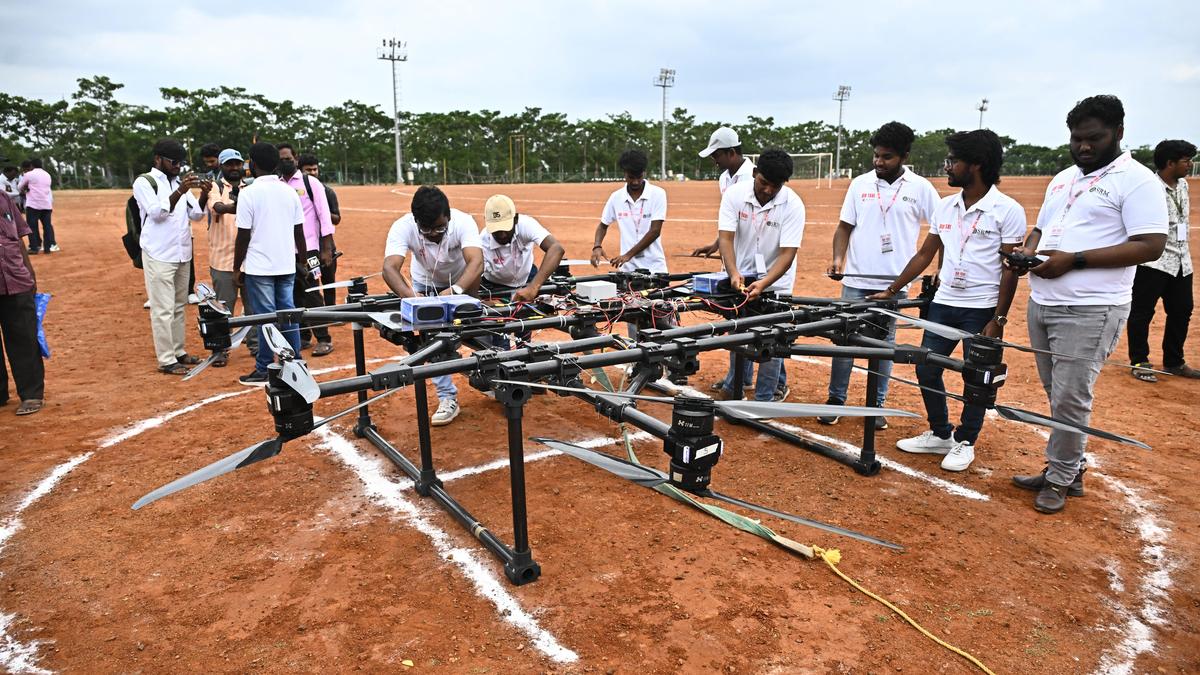
SRM-AP students develop indigenous electric air taxi
SRM University-AP has unveiled DOXI, an indigenous electric air taxi developed by a team of B.Tech students under the guidance of Pradyut Kumar Sanki, Associate Professor and Coordinator of the Centre for Drone Technology (CDT).
The prototype was unveiled with a live flight demonstration attended by A.P. State Quantum Mission Director C.V. Sridhar, Vice-Chancellor Ch. Satish Kumar, Dean of Research Ranjit Thapa, faculty members, and students.
Developed by Team Skyworks, DOXI is a 16-motor electric vertical take-off and landing (eVTOL) aircraft built on a lightweight carbon-fibre frame. The prototype can carry a payload of up to 80 kg, attain a top speed of 50 kmph, and remain airborne for up to 25 minutes. Its estimated operating cost is about ₹3.5 per kilometre.
The aircraft is designed for applications such as urban air mobility, air ambulance services, disaster relief, and emergency response. The project integrates aerospace engineering, embedded systems, artificial intelligence, automated flight control, and communication technologies.
Speaking on the occasion, Mr. Sridhar said the platform has the potential to support infrastructure monitoring, forest surveillance, and rescue operations. Vice-Chancellor Prof. Satish Kumar described the project as a reflection of the university’s commitment to innovation and research.
Mr. Sanki said the achievement underscored the importance of mentorship, research infrastructure, and an enabling academic environment in fostering indigenous technological innovation.
The project was executed by Team Skyworks, comprising Manikanta (Founder, Team Lead, and Chief Test Pilot), Ajit Kumar (Co-Lead), Sai Sankar, and Ch. Manikanta, K. Manoj Kumar, J. Sai Deekshith, Ashwith, B. Ramprasad Reddy, Agastya Pandey, and Sanjay, who handled software, avionics, embedded systems, testing, power electronics, CAD design, and documentation.
University officials said DOXI reflects SRM-AP’s commitment to indigenous technology development in line with the Make in India initiative and the growing demand for advanced urban mobility solutions.