


Andhra Pradesh to Bring New Law for Private Skill Universities
Andhra Pradesh is preparing to introduce a new law that will allow the establishment of private skill universities, marking a major push to align education with employment and build a strong industry-ready workforce in the state.
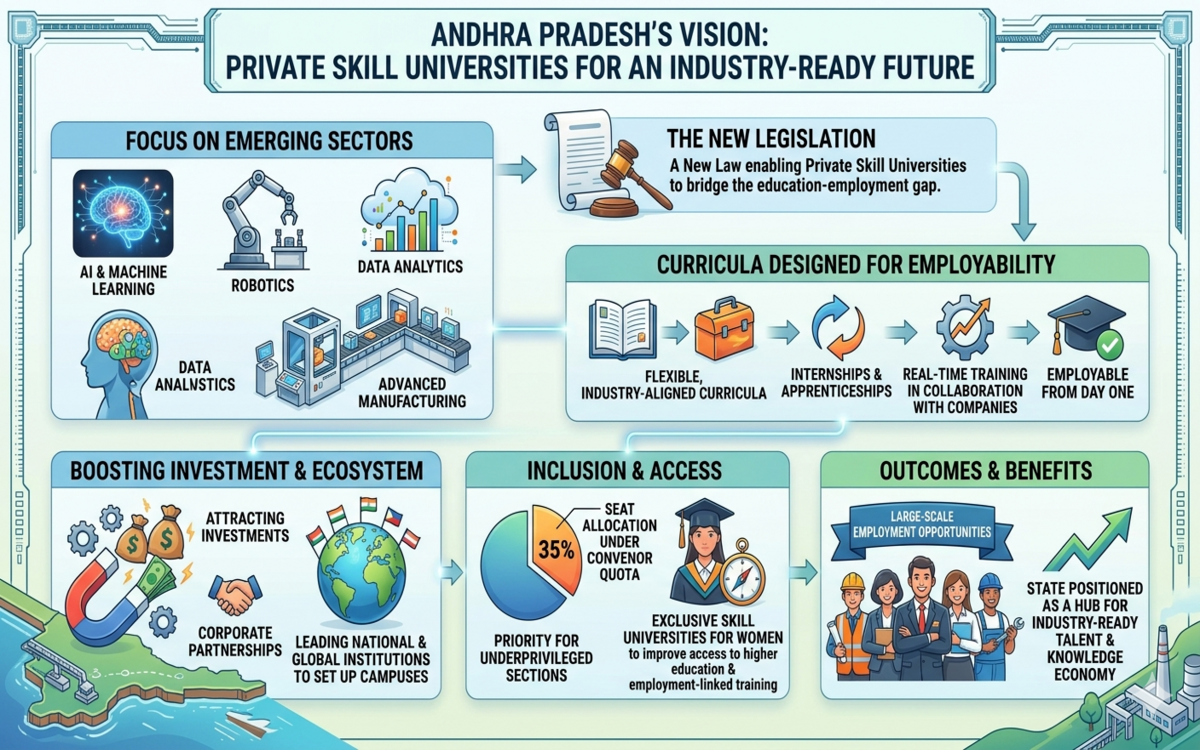
The proposed legislation will enable reputed private institutions to set up specialised universities focused on emerging fields such as artificial intelligence, robotics, data analytics, and advanced manufacturing. Officials said the initiative is expected to generate large-scale employment opportunities while attracting investment into the education and skilling ecosystem.
The government aims to address the long-standing gap between conventional degree programmes and industry requirements. Officials noted that although job markets increasingly demand practical skills, many graduates still lack hands-on training and exposure to new technologies.
Under the proposed framework, skill universities will design flexible, industry-aligned curricula with a strong emphasis on internships, apprenticeships, and real-time training in collaboration with companies. Digital learning platforms and corporate partnerships will play a key role in ensuring graduates are job-ready from day one.
The policy is also expected to boost investor confidence by opening structured participation for private players in higher education. The state plans to attract leading national and international institutions to establish campuses in Andhra Pradesh, further strengthening its position in the knowledge economy.
Sources said the universities will be permitted to offer certificate, undergraduate, and postgraduate programmes, including professional courses. A 35 per cent seat allocation under the convenor quota will be mandated, with priority given to students from underprivileged sections.
In a notable move towards inclusion, the government is also considering setting up exclusive skill universities for women to improve access to higher education and employment-linked training.
Industry participation will be strongly encouraged, with companies expected to establish their own skill universities to create sector-specific talent pipelines. Education experts have termed the initiative a significant step towards bridging the gap between academic learning and real-world job requirements.