


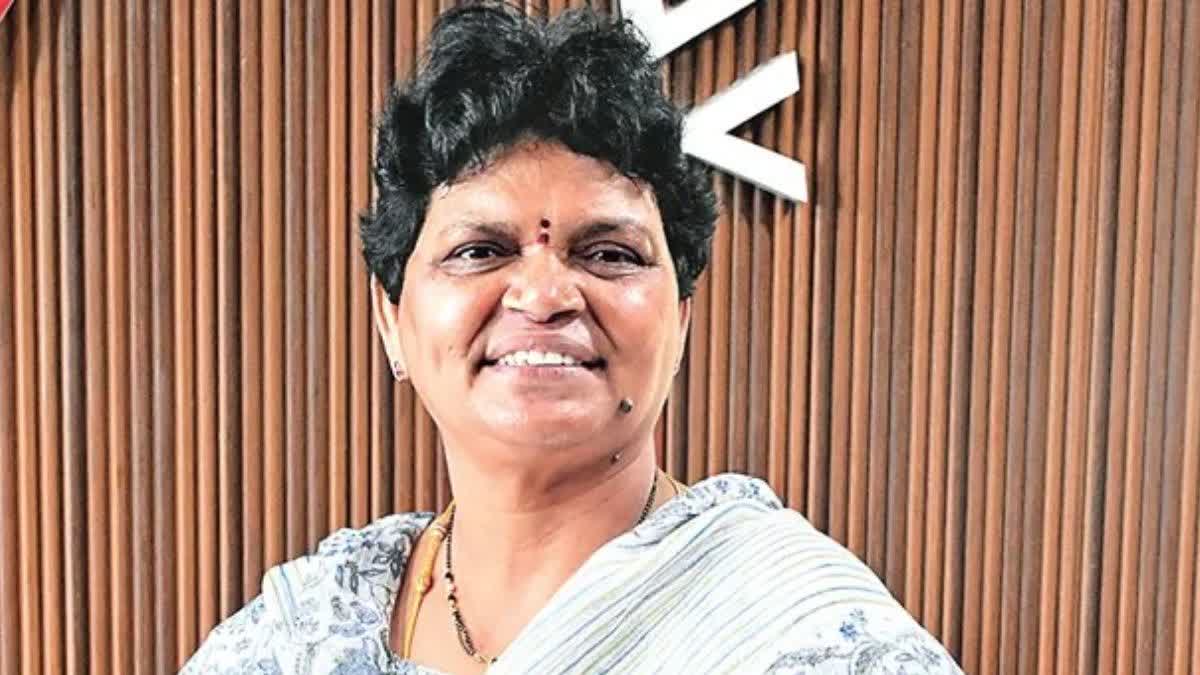
Ala Arunashree: A Trailblazer in Indian Railways
The rhythmic movement of trains, the bustle of passengers, and the constant demand for precision make railway operations one of the most challenging public service environments in the country. For nearly three decades, Ala Arunashree has navigated this demanding world with determination and composure, steadily overcoming barriers in a profession that has traditionally been dominated by men.
Her journey is one of perseverance as much as it is of professional achievement — one that led her to make history as the first woman Station Master in the 130-year-old Waltair Division, and later as the first woman Station Manager of Visakhapatnam Railway Station, one of the busiest railway hubs on the east coast.
Today, as manager of the Visakhapatnam Goods Yard under the South Coast Railway Zone, she continues to shoulder responsibilities that demand operational precision, quick decision-making, and constant vigilance.
Looking back on her career, Arunashree recalls that the road was far from easy.
“When I joined the Railways, many people felt that women were not suited for operational roles. Some said I would not last even three days in the job. Others suggested that I move to an administrative section,” she says.
Rather than allowing such remarks to discourage her, she chose to treat them as motivation.
“The bias and scepticism only strengthened my resolve. I decided to prove myself through my work,” she says.
Over the years, she took on assignments that many considered difficult, including night shifts and field duties that demanded physical endurance and mental alertness. Her commitment gradually earned the confidence of colleagues and superiors alike.
The nickname some of her colleagues use today reflects the reputation she has built over the years.
“When I walk along the platforms carrying a walkie-talkie, some people jokingly say, ‘The lioness has arrived.’ They know I will step in whenever there is a problem,” she says with a smile.
Much of that reputation was forged during moments of crisis.
During the 2004 Indian Ocean tsunami, she played a key role in coordinating passenger movement and facilitating evacuation through special train services. She continued her duties during Cyclone Hudhud, which devastated large parts of Visakhapatnam in 2014, and later during the COVID-19 pandemic, when railway services operated under extraordinary circumstances.
One of the most challenging situations she encountered was the Kantakapalli train accident, where swift decision-making was required to manage train movements and prevent panic among passengers.
Beyond operational responsibilities, she has often found herself responding to humanitarian situations.
“There were occasions when elderly passengers and poor travellers were stranded because services had been disrupted. I purchased tickets with my own money to help them return home,” she recalls.
Working in coordination with the Railway Protection Force (RPF), she also helped reunite several lost women and children with their families.
Her most demanding assignment came at Visakhapatnam Railway Station, classified as a special-category station, which handles heavy passenger traffic and complex train movements. Trains arriving at the station often require turn-around operations, where they must reverse out in the same direction they entered. Given its location on important railway corridors connecting Chennai, Kolkata, and Hyderabad, maintaining schedules is a constant challenge.
Staff must complete activities such as loading, unloading, inspections, and passenger management within a tight time window.
“Whenever technical issues arose, I preferred to be present on the ground. The presence of a supervisor gives confidence to the staff and helps ensure that work is completed efficiently,” she says.
Her ability to manage such responsibilities led to her appointment as Station Manager of Visakhapatnam Railway Station, a position she held for five years.
She is now entrusted with managing the Visakhapatnam Goods Yard, where freight operations play a crucial role in the movement of commodities and strategic cargo. The role is considered one of the most demanding in the railway system, with even minor errors carrying significant financial consequences.
Despite the challenges, Arunashree believes women are fully capable of handling operational responsibilities.
“Public service requires commitment, irrespective of gender. Women should not hesitate to take up night duties or challenging assignments. If we approach our responsibilities with confidence and dedication, recognition follows naturally,” she says.
Her career mirrors the gradual transformation taking place within Indian Railways, where women are increasingly assuming leadership positions across operational and managerial roles. While the titles she has earned remain significant milestones, it is perhaps her persistence in overcoming entrenched stereotypes that defines her legacy.
In a profession built on discipline, responsibility, and teamwork, Ala Arunashree’s journey stands as a reminder that competence and commitment remain the strongest credentials of all.