


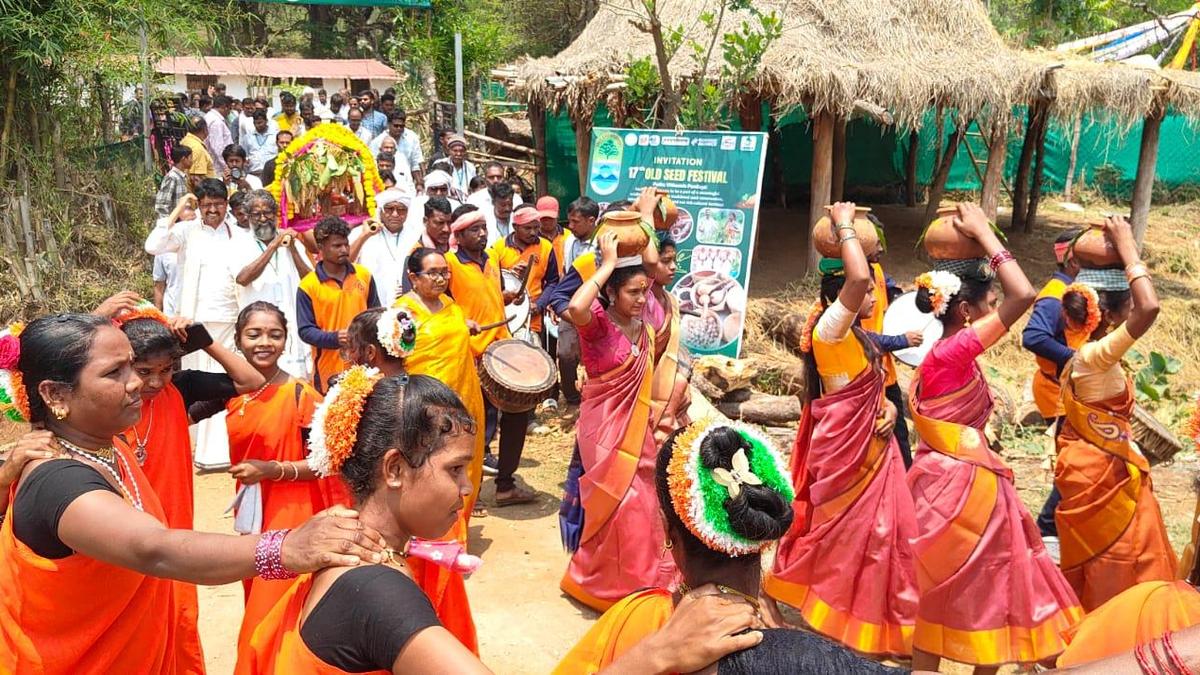
Indigenous seed diversity celebrated at Old Seed Festival in Araku
The 17th annual Old Seed Festival, organised by Sanjeevini, was held at Killoguda village in the Araku region of Alluri Sitharama Raju district on Tuesday, bringing together Adivasi farmers, researchers and civil society representatives to promote the conservation of indigenous seeds and natural farming practices.
Farmers from Araku, Rampachodavaram, the Nilgiris in Tamil Nadu, and Koraput in Odisha displayed a wide variety of traditional seeds, showcasing the ecological richness of tribal farming systems across southern India.
The programme began with a village procession in which participants carried preserved seed varieties. Traditional drum performances and Dhimsa dances added colour to the celebrations.
A major attraction at the festival was the exhibition of 80 varieties of tuber seeds presented by farmers from Gondivalasa village in Dumbriguda mandal. Visitors interacted with the farmers to learn about seed preservation methods and the climate resilience of indigenous crops.
T Baburao Naidu, Executive Director of Rythu Sadhikara Samstha, visited the stalls and held discussions with participants on cultivation methods and seed characteristics.
In the seed exhibition competition, Sukri of Gondivalasa, Manikanta from Tamil Nadu, and Pratik Mori from Maharashtra were felicitated.
At a meeting presided over by Pachari Devullu, Ravi Varma, Vijayaram, Pathro, Srinivas, and Jacob Nellithanam, representatives of various organisations and research institutions praised Sanjeevini for its sustained efforts over the past 17 years in conserving native seeds.
Environmental activists Sohan Atangadi, Jayashree Atangadi, P. Varalakshmi, Seetharam, K. Manmadha Rao, Prakash, M.N.R. Varma, and G. Srinivas were among those present.
Participants called for greater institutional support and formal recognition of organic farming clusters in the Araku region, stating that such initiatives could strengthen ecological sustainability and improve livelihoods in tribal areas.